
Guide6 minute read
Hair dye patch tests: when your salon needs one, and how to keep a record
Patch test a client at least 48 hours before you colour their hair, test again at least every six months or whenever something changes, and write down the date, the product and the result every time. If there is any reaction, you don't colour.

Director, FullDiary
It takes two minutes and a cotton bud. Skipping it is how a good colour client becomes a swollen face, a complaint and an insurance claim. Here is how to do it properly, and how to make sure nobody slips through when the diary is busy.
What a patch test is, and why it matters
A patch test (the industry now calls it an allergy alert test) is a small dab of the colour you plan to use, left on the client's skin to see whether it reacts. You check it before the colour appointment, and if there's any reaction, the colour doesn't happen.
The usual culprit is PPD (paraphenylenediamine), which is in many permanent and some semi-permanent dyes. Most reactions are mild: itching, stinging, a rash. A few are serious, and the NHS says symptoms can take up to 72 hours to appear.
An allergy can start at any age, even in a client who has coloured their hair for twenty years. "I've never had a problem" isn't a reason to skip it. It's the reason the rules say to test again regularly.
There's a business reason too. If a client reacts, the first thing anyone asks is whether you tested, when, and with what. A test with no record is very hard to prove. Most salon insurance expects you to follow the industry testing rules, so check what your own policy says.
How long before, and how often
Test at least 48 hours before the colour. That's the National Hair & Beauty Federation's rule, and it's in most dye makers' instructions, because a reaction can take that long to show. When to test, by the NHBF's rules:
- A new client: test at least 48 hours before their first colour.
- Six months or more since their last test: test again.
- You've changed colour brand or product: test again.
- A tattoo or black henna tattoo since: test again, and if the henna tattoo reacted, don't colour at all.
- Same product, tested within six months: no new test needed, but still ask the questions.
- Under 16: don't test or colour.
Where a dye maker's instructions are stricter than this, they win. Some brands ask for a test before every application, so read the leaflet for each product you use. If you're not sure whether a test is needed, do one.
How to do one, and what to write down
- Ask first. Any reaction to hair dye before, ever? Any skin conditions, allergies or medication? A tattoo or black henna tattoo since you last saw them? If they've ever reacted to a colour, or the scalp is broken or irritated, stop there: no colour.
- Test with the product you'll use. Apply it where the dye maker's instructions say, or use an approved test kit (check which ones your insurer accepts). The NHBF suggests testing the shade you plan to use, or black if you don't know yet.
- Tell the client what to watch for. Itching, burning, redness or swelling over the next 48 hours means call you, and don't come in for the colour.
- Check before you colour. At the colour appointment, ask how the test went and look at the spot. Any reaction means no colour with that product.
Then write it down. The NHBF says to keep a written record of every test, signed by the client, for at least six years. Each record should show:
- the date of the test
- the brand, product and shade tested
- who did it
- the result, and the date you checked it
- the client's answers to your questions, and their signature or typed name
A paper record card in a drawer works until someone loses it, or the client books with a new stylist who doesn't know it exists.
When a client says no, forgets, or reacts
- They don't want a test. Then they don't get the colour. Offer the cut or the blow dry instead, and put "no test, no colour" in your booking policy so it isn't a conversation on the day.
- They forgot to come in for it. Move the colour to at least 48 hours after the test. It's annoying for both of you, which is why asking for the test at the moment they book matters so much.
- The test reacts. Don't use that product. Advise them to get medical advice, write the reaction on their record, and tell the dye maker. If there's any chance it becomes a claim, tell your insurer straight away.
- They react during or after a colour. Stop, and follow the product's first aid instructions. The NHS says to call 999 if their lips, mouth, throat or tongue swell, or they struggle to breathe. A clear test doesn't guarantee nothing will happen, so keep an eye out every time.
Asking at the moment they book, with FullDiary
The hard part isn't the test. It's remembering who needs one, on a busy Saturday, when a colour client books online at 11pm. FullDiary asks for you.
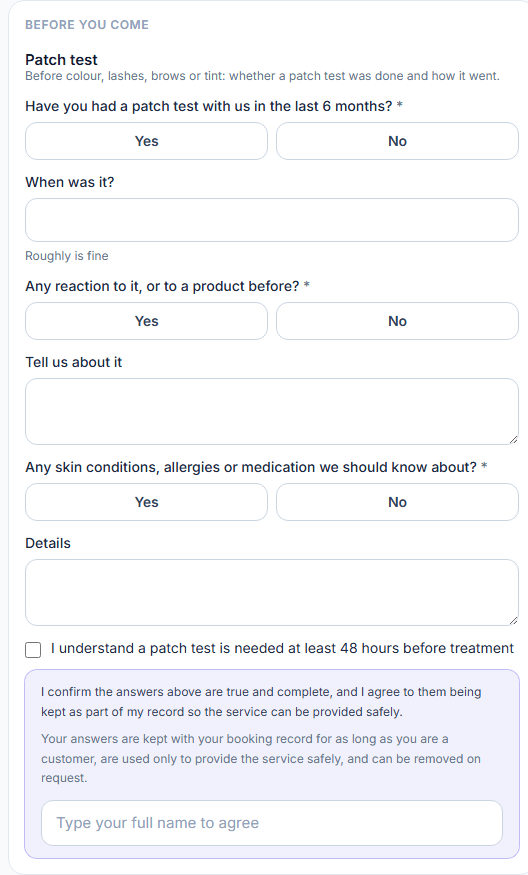
- Add the Patch test form under Your shop, Forms, and choose the services it's for: colour, toner, lash and brow tint, whatever needs it.
- Clients answer it as they book, before the booking goes through: whether they've had a patch test with you in the last six months, any reaction before, any skin conditions, allergies or medication. They tick that they understand a test is needed at least 48 hours before.
- It's asked again once six months have passed, on their first booking after that, and never twice inside that window. Change the questions to suit you, for example adding one about tattoos.
- The answers live on the client's profile, with the date and their typed name, as a PDF you can download.
- The diary shows it on every booking, so whoever is doing the colour can see at a glance whether the form is done.
- Already tested your regulars before you switched? Mark the form "Don't require for this customer" until the date their test runs out.
FullDiary asks the questions and keeps the record. The test itself is still you, the product and 48 hours. Forms are free on every plan.
How FullDiary works for hair salons
Where these rules come from
The testing rules above are the National Hair & Beauty Federation's allergy alert testing guidance.
NHBF: setting up an allergy alert testing system
Its insurance guidance covers shade changes, black henna tattoos and what to do after a reaction.
NHBF: allergy alert tests and your insurance
The NHS explains hair dye reactions and when to get urgent help.
This guide is general information for salons, not medical or legal advice. Always follow the dye maker's instructions and your insurer's terms.
Questions people ask
- How long before a colour does a patch test need to be done?
- At least 48 hours before, so any reaction has time to show.
- How often does a regular client need a patch test?
- The NHBF says every six months, and sooner if you change colour brand or product, or they've had a tattoo or black henna tattoo. Where the dye maker asks for more, follow the dye maker.
- Do I need a new patch test if I'm only changing the shade?
- Not always. The NHBF says a shade change alone doesn't need a new test under its insurance scheme, but it still suggests testing the shade you plan to use. Check your own insurer's terms.
- Can I patch test or colour someone under 16?
- No. The NHBF says not to patch test or colour anyone under 16.
- How long should I keep patch test records?
- At least six years, with the client's signature, according to the NHBF.
- If the patch test was clear, can they still react?
- Yes. A clear test lowers the risk but doesn't remove it, so watch for itching, burning or swelling during every colour, and stop if it starts.
Read next
Written by
Matt SucklingDirector, FullDiary
Matt runs Cynical Software Ltd, the Perthshire company that makes FullDiary, and builds it.