
Guide6 minute read
PAR-Q form: a free health questionnaire for personal trainers
A PAR-Q is a short set of yes or no health questions a client answers before they start training with you. Copy the questions below, ask them before the first session, and if any answer is yes, talk it through and get their GP's advice before you push them.

Director, FullDiary
Before a new client lifts anything, you need to know whether there's a reason they shouldn't. A PAR-Q is how you ask: a handful of yes or no questions, answered before the first session, that pick out the few people who need a doctor's view first so everyone else can get going.
What a PAR-Q is, and isn't
PAR-Q stands for Physical Activity Readiness Questionnaire. It started in Canada, and the official version today, the PAR-Q+, is published by the PAR-Q+ Collaboration. Gyms and trainers across the UK use it or a form like it.
- It is a screen. It finds the clients who should talk to their GP before training starts or steps up.
- It isn't a diagnosis. You're not a doctor, and a form doesn't make you one. A yes is a reason to talk, not a verdict.
- It isn't a law, but it is standard practice. Check what your insurer and the gym you train clients in expect, and keep the answers on your client's record.
The template: questions to copy
These are our own wording of the questions trainers usually ask. Copy them, cut what doesn't apply and add your own. If you'd rather use the official PAR-Q+, download the current version from the PAR-Q+ Collaboration and use it as they publish it.
Part 1, about you:
- Full name
- Date of birth
- Mobile number and email address
- Emergency contact: name and phone number
- Your GP's name and surgery
Part 2, your health (yes or no):
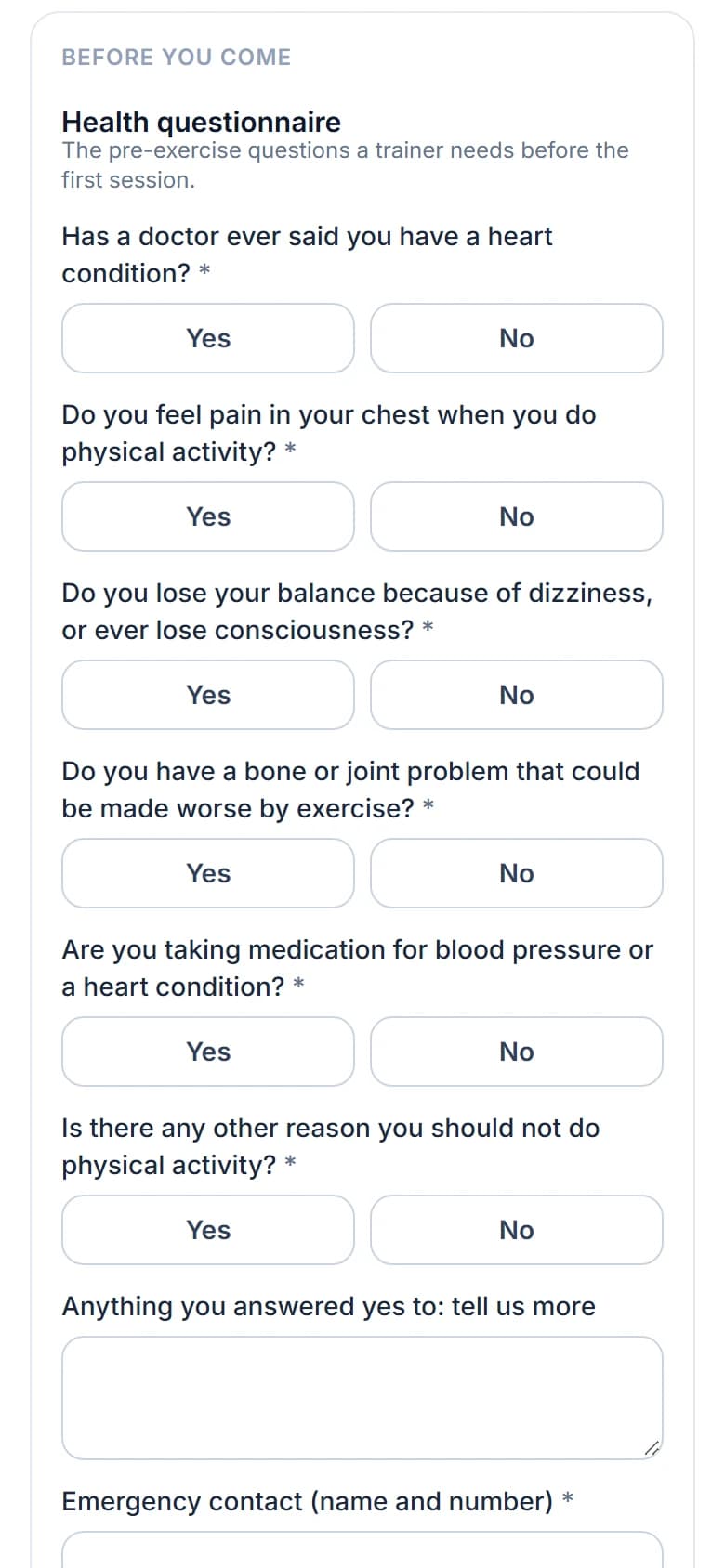
- Has a doctor ever told you that you have a heart condition, or that you should only exercise with medical advice?
- Do you get pain in your chest when you're active?
- In the last month, have you had chest pain when you weren't being active?
- Do you ever lose your balance because you feel dizzy, or have you ever blacked out?
- Do you have a bone, joint or back problem that exercise could make worse?
- Are you taking any medication for your blood pressure or your heart?
- Is there any other reason you think you shouldn't exercise?
- If you answered yes to anything, tell us more.
Part 3, the extras many trainers add:
- Are you pregnant, or have you had a baby in the last year?
- Have you had an operation or an injury in the last year?
- Do you have asthma, diabetes or epilepsy?
- How active are you in a normal week right now?
- What do you want to get out of training?
Part 4, agreement:
- My answers are true and complete, and I'll tell you if anything changes.
- I understand that if I answered yes to any health question, I should get my GP's advice before I start or increase my training.
- I agree to my answers being kept on my client record so you can train me safely.
- Signature, or full name typed, and the date
If a client answers yes
- Talk to them first. Ask what it is, when it started and what their doctor has said. Plenty of yeses, like an old knee injury, only change how you train them.
- Heart, chest pain, dizziness or blood pressure medication: ask them to check with their GP before you start, and note what the GP said on their record.
- Start gently. The UK Chief Medical Officers' guidelines say to build up gradually from where someone is now, and that some activity is better than none.
- Know where your training stops. For a condition outside what you're qualified for, refer them on, to their GP or a trainer qualified in it. The official PAR-Q+ has follow-up pages for people living with a long-term condition.
How often to ask again
- Before the first session: the full form, answered before they arrive, not on a clipboard in the gym.
- Before each new block or programme: a quick "has anything changed since last time?"
- Once a year, the full form again, and sooner after an illness, an injury, an operation, a pregnancy or new medication.
Keeping the answers safe
Health answers are "special category" data under UK GDPR. The ICO says you need a lawful reason to keep them plus an extra condition, such as the client's explicit consent, which is what the agreement in part 4 is for. Keep them somewhere secure, not as a photo in your camera roll or a WhatsApp chat, and decide how long you keep them, then delete them after.
Asking it when they book, with FullDiary
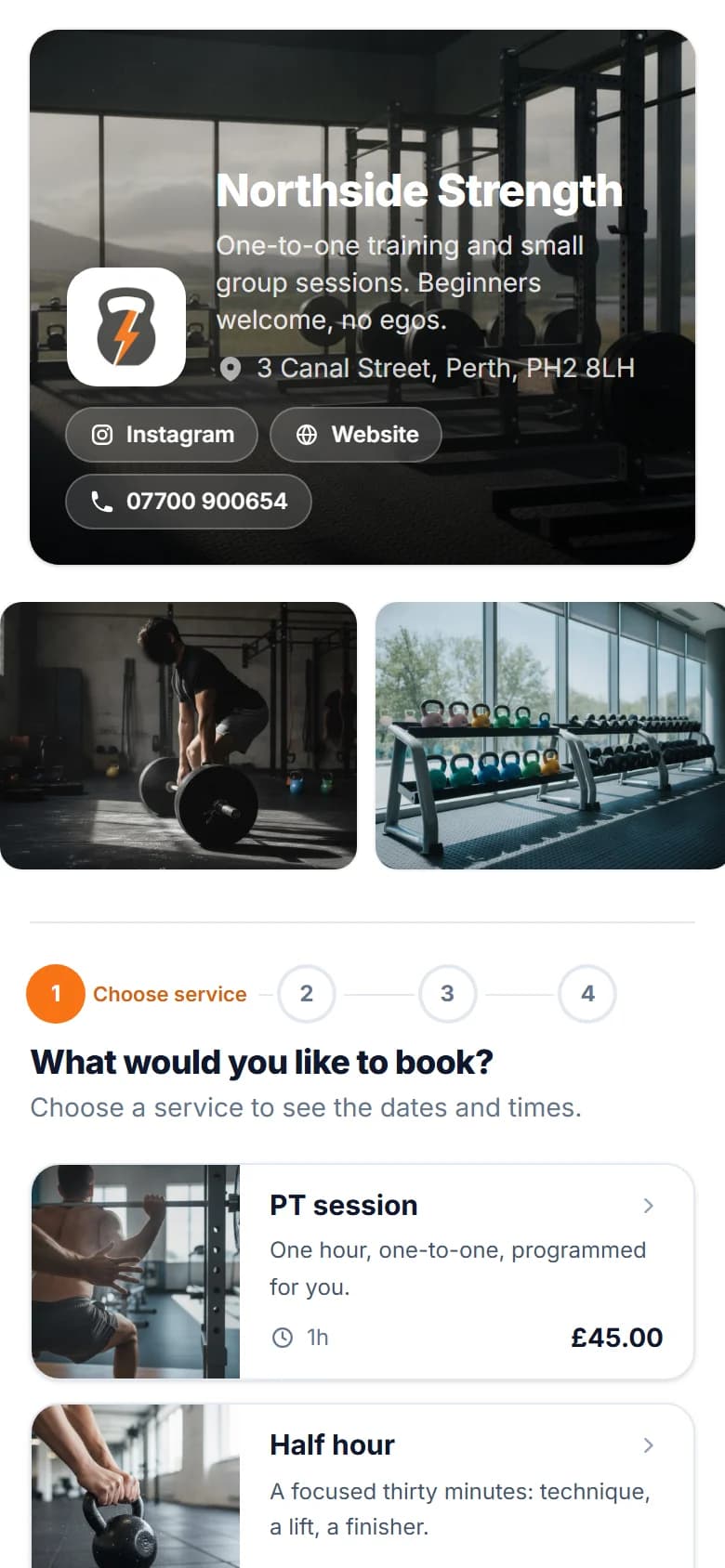
The best time for a PAR-Q is before the client walks in. FullDiary asks it on your booking page, so it's done before the first session.
- Start from the Health questionnaire template under Your shop, Forms. It has the core questions, a box for anything they answered yes to, and an emergency contact, and you can add the extras above as yes or no, short or long answers.
- Choose the services it's for, such as your PT sessions and assessments.
- Clients answer it on your booking page as they book, under Before you come, before the booking goes through. Booked by phone? Their booking page and confirmation email ask for it.
- It's asked on the first visit and again after a year, or every visit, or only when you send it: your choice.
- Every answer is kept on the client's profile with the date and their typed name, as a PDF, and the form ends with the agreement and a line saying how long the answers are kept.
- The diary shows it on each booking, so you know before the session whether it's done.
Forms are free on every plan.
How FullDiary works for personal trainers
Where this comes from
The official PAR-Q+, its follow-up pages and its guidance for exercise professionals.
How much activity adults need, and building up gradually.
UK Chief Medical Officers' physical activity guidelines
The ICO explains health information as special category data.
And how long to keep personal data.
This guide is general information, not medical or legal advice. If a client's answers worry you, ask them to see their GP before you train them.
Questions people ask
- Is a PAR-Q a legal requirement in the UK?
- No law requires one, but it's standard practice for personal trainers and gyms, and your insurer or the gym you work in may expect it. Check what they ask for.
- What should I do if a client answers yes?
- Talk to them about it. For anything about the heart, chest pain, dizziness or blood pressure medication, ask them to check with their GP before you start. Many yeses, like an old injury, just change how you train them.
- How often should clients fill in a PAR-Q?
- Before the first session, then once a year, and sooner after an illness, an injury, an operation, a pregnancy or new medication.
- Can I use the official PAR-Q+?
- Yes: download the current version from the PAR-Q+ Collaboration's website and use it as published. They ask people not to use out-of-date or changed copies.
Read next
Written by
Matt SucklingDirector, FullDiary
Matt runs Cynical Software Ltd, the Perthshire company that makes FullDiary, and builds it.