
Guide7 minute read
Salon consultation and consent form: a free template to copy
A good consultation form asks four things: who the client is, their health and allergies, what they want from today's treatment, and their agreement, signed and dated. Copy the template below, cut what doesn't apply, and get it filled in before the appointment, not at the chair.

Director, FullDiary
A form isn't paperwork for its own sake. It's how you find out about the allergy, the medication or the recent sunburn before it becomes your problem, and it's your record that you asked.
Consultation form or consent form?
They're two halves of the same job, and most salons put them on one sheet.
- The consultation form is the questions: health, allergies, medication, what they've had done before and what they want today. It tells you whether the treatment is safe, and how to do it.
- The consent form is the agreement: they've told you the truth, you've explained the treatment and its risks, and they're happy to go ahead. It's signed and dated.
Together they protect both of you. The client gets a treatment that suits their skin, hair and health. You get a record that you asked, they answered and they agreed, which matters if anything ever goes wrong.
The template: questions to copy
Copy what you need and cut the rest. A barber doesn't need the pregnancy question; a waxing client needs the medication and sunburn ones. The shorter the form, the more honestly it gets filled in.
Part 1, about you:
- Full name
- Date of birth
- Mobile number and email address
- Emergency contact: name and phone number
Part 2, your health:
- Do you have any allergies, for example to hair dye, latex, plasters, nuts or skincare products? If yes, what?
- Are you taking any medication, including creams, antibiotics or acne treatment?
- Do you have any skin conditions, such as eczema, psoriasis or dermatitis?
- Are you pregnant or breastfeeding?
- Do you have diabetes, epilepsy, a heart condition or a blood disorder?
- Is there anything else about your health we should know?
Part 3, today's treatment:
- Have you had this treatment before? Did you have any reaction?
- For colour, lashes, brows or tint: have you had a patch test with us in the last six months?
- Have you had a tattoo or black henna tattoo since your last visit?
- Any recent sunburn, fake tan or sunbed use?
- What would you like from today's appointment?
Part 4, agreement:
- I confirm my answers are true and complete, and I'll tell you if anything changes before a future appointment.
- The treatment, its risks and the aftercare have been explained to me, and I have had the chance to ask questions.
- I agree to my answers being kept on my client record so you can treat me safely.
- Signature, or full name typed, and the date
- If the client is under 18: a parent or guardian's name and signature
Leave a space under part 3 for your own notes: what you agreed, the products you used and the patch test result. Next time, that's the first thing you'll want to read.
Hair dye patch tests: when your salon needs one
When to ask, how to sign, how long to keep it
- When to ask. A sensible rhythm: the full form before the first appointment, a quick "has anything changed since last time?" at every visit after that, and the full form again once a year or when they book a different kind of treatment.
- Getting it signed. Ink isn't required. In England and Wales, the Law Commission confirmed in 2019 that an electronic signature, such as a typed name, can sign a document when the person means it as their signature. What matters is that you can show who agreed, to what, and when.
- Keeping it safe. Answers about health are "special category" data under UK GDPR, which the ICO says needs a lawful reason plus an extra condition, such as the client's explicit consent. That's what the agreement line in part 4 is for. Keep the forms where only the people treating the client can see them: a locked drawer, not the reception desk.
- How long to keep it. UK GDPR doesn't set a number. The ICO says to decide a period you can justify, not keep things "just in case", and delete them after. For patch tests the NHBF advises at least six years, and your insurer may ask for something similar for other records, so check your policy.
Under 18s, and treatments with an age limit
This is why the template asks for a date of birth. Some treatments are against the law for under-18s, whatever a parent says:
- Tattoos: illegal on anyone under 18, under the Tattooing of Minors Act 1969 (England, Wales and Scotland).
- Sunbeds: a business must not let anyone under 18 use one, under the Sunbeds (Regulation) Act 2010 (England and Wales).
- Botox and cosmetic fillers: illegal to give to anyone under 18 in England, under the Botulinum Toxin and Cosmetic Fillers (Children) Act 2021.
- Hair colour: the NHBF says not to patch test or colour anyone under 16.
For everything else, it's your call. A sensible policy: ask a parent or guardian to sign for anyone under 18, and to come along to their first appointment.
Asking it before they arrive, with FullDiary
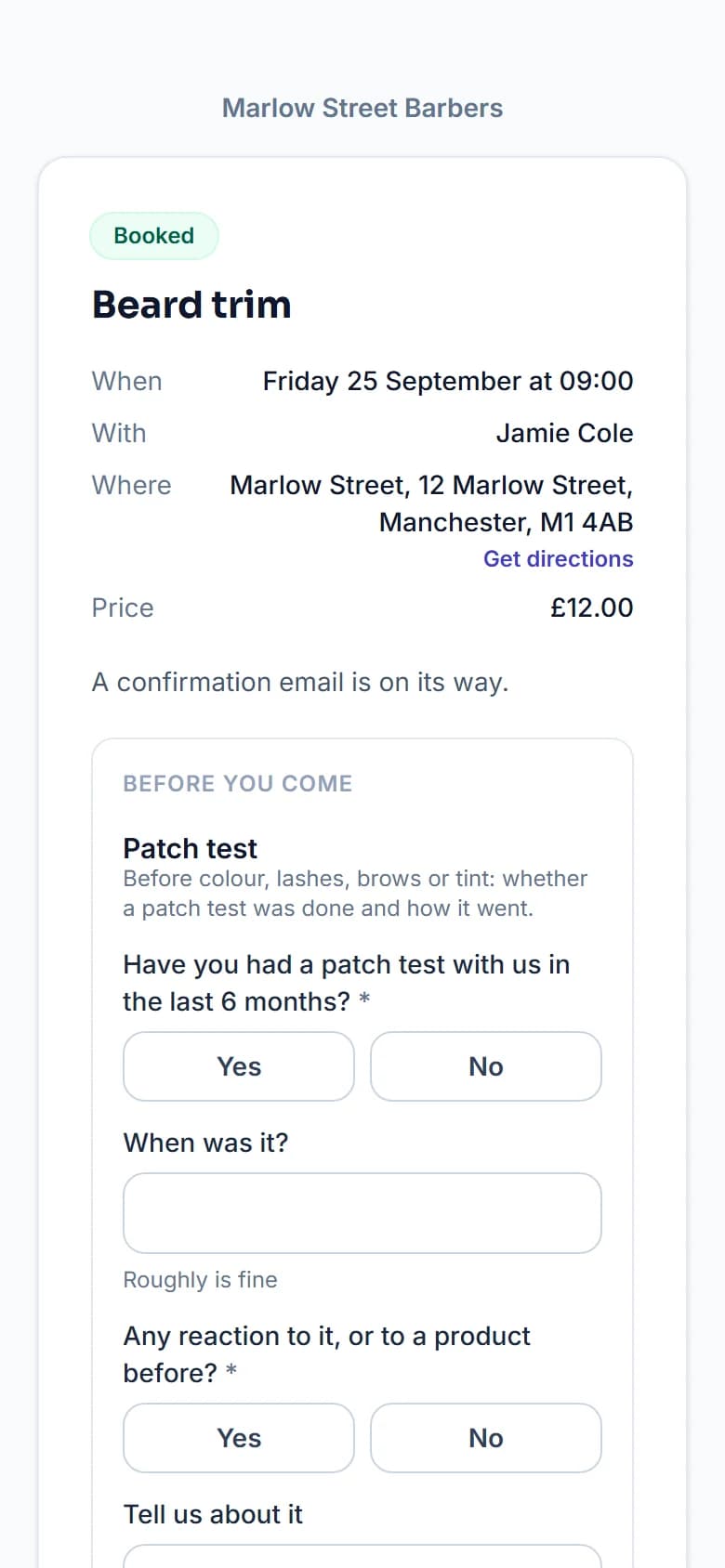
A form on a clipboard gets filled in at the chair, in a rush, with the appointment already running late. FullDiary asks it when they book.
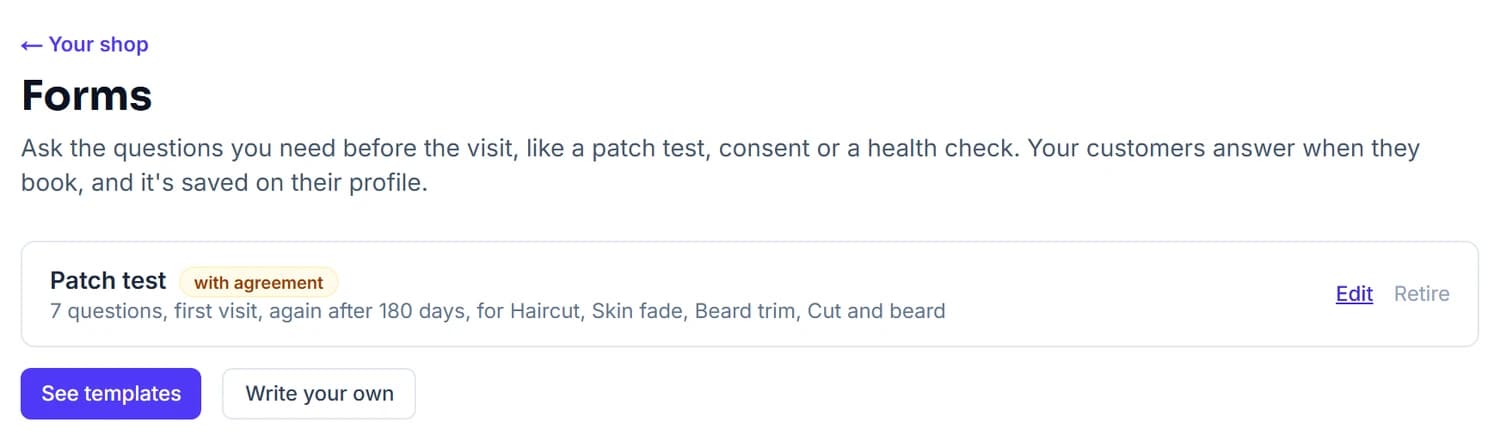
- Start from a template or write your own under Your shop, Forms. There are ready-made ones (patch test, consent to treatment, tattoo consent and more), and you can type in the questions above as yes or no, short or long answers, pick lists and tick boxes.
- Choose the services it's for, so a colour client gets the colour questions and a cut doesn't.
- Clients answer it on your booking page as they book, before the booking goes through. Booked by phone? Their booking page and confirmation email ask for it.
- Choose how often: on the first visit and again after a set time, every visit, or only when you send it. For example, the full form once, and Consent to treatment ("anything changed since last time?") every visit.
- Every answer is kept on the client's profile with the date and their typed name, as a PDF, and health and consent forms end with the agreement and a line saying how long the answers are kept.
- The diary shows it on each booking, so you know before they sit down whether it's done.
Forms are free on every plan.
How FullDiary works for beauty salons
Where these rules come from
The ICO explains health information as special category data, and how long to keep personal data.
Its storage limitation principle says to decide a retention period you can justify.
The Law Commission's 2019 report on electronic signatures, summarised by the law firm Womble Bond Dickinson.
Electronic signatures are valid: the Law Commission's report
The age limits are in the Acts themselves.
Sunbeds in England and Wales.
Botox and fillers in England.
Botulinum Toxin and Cosmetic Fillers (Children) Act 2021
Patch test records and under-16s, from the National Hair & Beauty Federation.
NHBF: setting up an allergy alert testing system
This guide is general information, not legal or medical advice. Check your insurer's terms and your own treatment training.
Questions people ask
- Is a typed name as good as a signature?
- In England and Wales, yes, when the client means it as their signature: the Law Commission confirmed in 2019 that an electronic signature can sign a document.
- How often should clients fill in a consultation form?
- The full form before their first appointment, a quick "anything changed?" every visit, and the full form again once a year or for a new kind of treatment.
- How long should I keep consultation forms?
- UK GDPR sets no fixed period, so decide one you can justify and delete them after it. The NHBF advises at least six years for patch test records, and your insurer may ask for something similar.
- Do I need consent to keep health information?
- Health answers are special category data, so the ICO says you need a lawful reason and an extra condition, such as the client's explicit consent. A clear agreement line on the form covers the consent part.
- What if a client won't fill in the form?
- Then you can't check the treatment is safe for them, so don't go ahead. Offer a treatment that doesn't need it instead.
Read next
Written by
Matt SucklingDirector, FullDiary
Matt runs Cynical Software Ltd, the Perthshire company that makes FullDiary, and builds it.