
Guide5 minute read
Tattoo consent form: a free template for UK studios
A tattoo consent form checks the client is 18 and fit to be tattooed today, records that they approved the design and placement, and gets their signature. Ask it at every sitting, check photo ID, and keep the forms safe.

Director, FullDiary
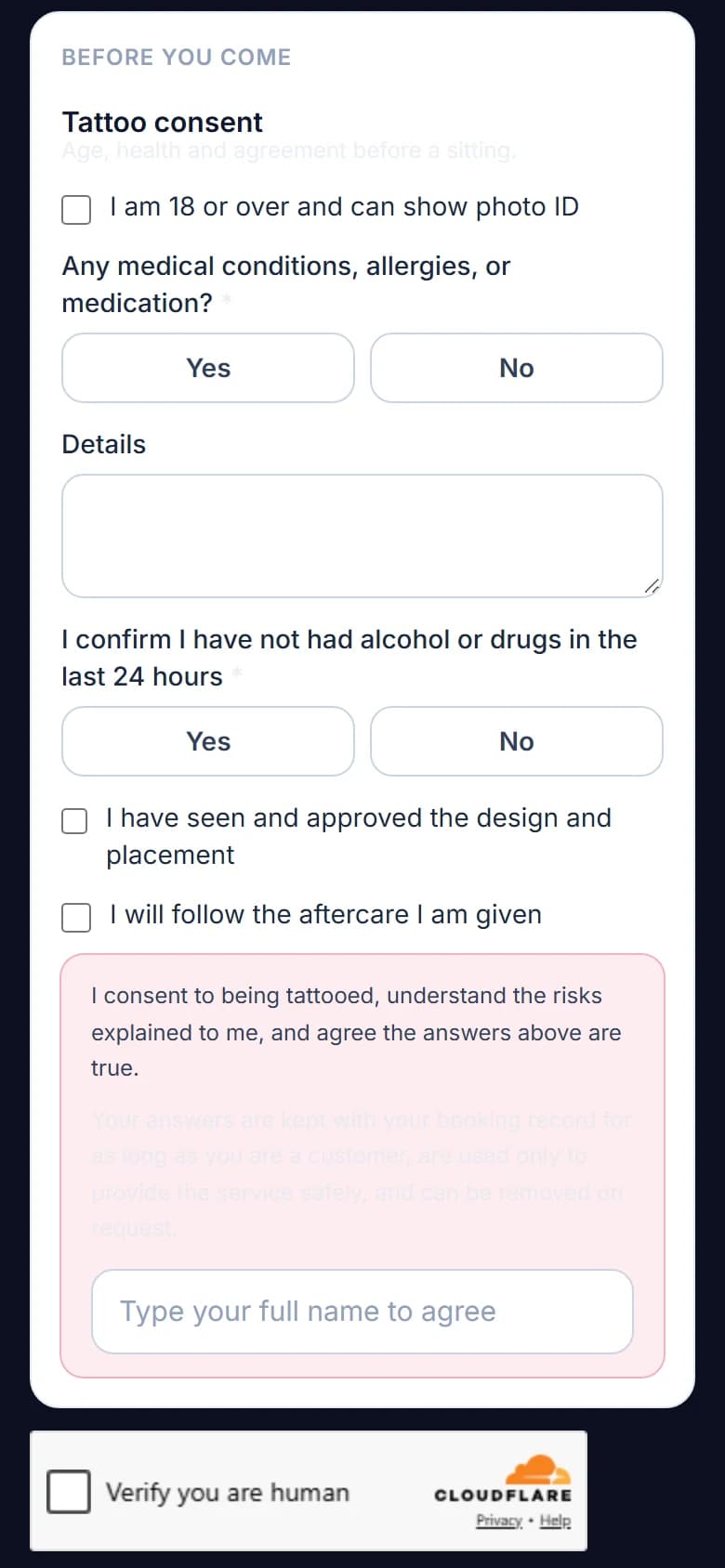
A consent form is how a studio shows it did things properly: checked the client's age, asked about their health, agreed the design and explained the aftercare. If a client has a reaction, or comes back unhappy, the signed form is your record of what was agreed.
Who must sign
The person being tattooed, and only once you're sure they're 18 or over. Under the Tattooing of Minors Act 1969 it's an offence to tattoo anyone under 18, except for medical reasons by a doctor. A parent's permission makes no difference, so there's no guardian line on a tattoo consent form.
Age and ID
- Check photo ID for anyone who might be under 25: a passport, a driving licence or a PASS card.
- Note on the form what you checked.
- If there's any doubt, don't tattoo. A believable story isn't a defence.
Health questions
You're asking about anything that affects healing, bleeding, infection or a reaction to the ink:
- Do you have any allergies, for example to latex, plasters, metals or pigments?
- Are you taking any medication, including blood thinners, steroids or acne treatment?
- Do you have diabetes, epilepsy, a heart condition, a bleeding disorder or a skin condition where we're tattooing?
- Are you pregnant or breastfeeding?
- Have you ever fainted during a tattoo, piercing or injection?
- Have you had alcohol or drugs in the last 24 hours?
The design and placement
Get the client to confirm, on the form, that they've seen the final design, its size and where it's going, and that the spelling on any lettering is right. A photo of the stencil in place, kept with the form, is the best record of all.
Aftercare and photos
- They've had the aftercare explained, and been given it in writing.
- They know healing takes time and that a touch up may be needed.
- They agree, or don't, to photos of the tattoo on your portfolio and social media. Make this its own tick, not hidden in the main agreement.
The template
Copy it and cut what you don't need.
- Full name, date of birth, phone number and email
- ID checked: type and last four digits (filled in by the artist)
- Do you have any allergies, medical conditions or take any medication? If yes, details.
- I confirm I have not had alcohol or drugs in the last 24 hours.
- I have seen and approved the design, its size and its placement.
- The aftercare has been explained to me and I will follow it.
- I agree / do not agree to photos of my tattoo being used on the studio's portfolio and social media.
- I am 18 or over. I consent to being tattooed, understand the risks explained to me, and confirm my answers are true. Signature, or full name typed, and the date.
Registration and licences
The rules on the studio itself depend on where you are. Check your council's page before you open:
- England: where the council has adopted Part VIII of the Local Government (Miscellaneous Provisions) Act 1982, tattooists and their premises must be registered, and the council's byelaws on hygiene apply.
- London: boroughs that have adopted the London Local Authorities Act 1991 license tattooing as a special treatment, with one licence covering the person and the premises.
- Scotland: a skin piercing and tattooing licence from the council, under the Civic Government (Scotland) Act 1982.
- Wales: since 29 November 2024, a special procedures licence for each practitioner and an approved premises, under the Public Health (Wales) Act 2017.
Keeping the forms
A consent form holds health information, which is special category data under UK GDPR: keep it locked away or behind a password, let only the people who need it see it, and decide how long you keep it. Your council's licence conditions may set a minimum, so check them; many studios keep forms for several years in case of a complaint or an insurance claim.
Asking it before the sitting, with FullDiary
- A Tattoo consent form is ready to add under Your shop, Forms: 18 or over with photo ID, health and medication, no alcohol or drugs in the last 24 hours, the design and placement approved, and the aftercare.
- Asked at every sitting, on your booking page when they book, for the services you pick. Anything not done yet is asked on their booked page and in the confirmation email.
- Signed with a typed name, with the agreement wording and a line on how the answers are kept, and saved as a PDF from the customer's profile.
- Photos agreed separately: the Model release template asks permission to use photos on your portfolio and social media.
- Deposits per service, so a half-day sitting is held with money down. On every plan.
Forms are on every plan, free included. Checking photo ID is still yours to do on the day.
Sources
The offence of tattooing anyone under 18.
Registration of tattooists and their premises in England (sections 15 to 17).
Local Government (Miscellaneous Provisions) Act 1982, Part VIII
A London borough's special treatment licence, as an example of how London councils license tattooing.
Tower Hamlets: special treatments licence
Licensing of skin piercing and tattooing in Scotland.
Civic Government (Scotland) Act 1982 (Licensing of Skin Piercing and Tattooing) Order 2006
Special procedures licensing in Wales.
Law Wales: Public Health (Wales) Act 2017
Health data is special category data under UK GDPR.
Typed signatures: the Law Commission's 2019 report on electronic signatures, summarised by the law firm Womble Bond Dickinson.
Electronic signatures are valid: the Law Commission's report
This guide is general information, not legal advice.
Questions people ask
- Can a 16 or 17 year old get a tattoo with a parent's consent?
- No. Under the Tattooing of Minors Act 1969 it's an offence to tattoo anyone under 18 in the UK, whatever their parents say.
- What should a tattoo consent form include?
- Age and ID, health and medication, alcohol or drugs in the last 24 hours, the design and placement approved, aftercare, permission for photos, and a signature and date.
- Does a client need a new consent form for every sitting?
- Yes, it's good practice. Health, medication and how they feel on the day can all change between sessions.
- How long should a tattoo studio keep consent forms?
- As long as you need them, kept securely under UK GDPR. Check your council's licence conditions, which may set a minimum.
- Can a client sign a tattoo consent form online?
- Yes. A typed name and date is a valid way to agree in England and Wales when the person means to sign. You still check their photo ID in person.
Read next
Written by
Matt SucklingDirector, FullDiary
Matt runs Cynical Software Ltd, the Perthshire company that makes FullDiary, and builds it.