
Guide5 minute read
Lash extension consent form: what to ask and why
Lash adhesive is one of the commonest causes of allergy in beauty, so a lash consent form is about more than a signature. Ask about eyes, allergies and past reactions, patch test new clients, explain aftercare and removal, and get it all agreed before the first set.

Director, FullDiary
Most clients will never react to a set of lashes. But allergic reactions to lash adhesive do happen, sometimes after several sets with no trouble, and they happen to the eyes. A consent form is how you find the clients at risk before the glue goes on, and your record that you asked.
Why lash techs use a consent form
- Allergy is real. Lash glues are cyanoacrylate-based, part of the acrylate family. A study of 4,931 patients at UK and Irish dermatology clinics found 2.4% allergic to at least one (meth)acrylate, and 60% of those had become allergic through nail enhancements or nail or eyelash glue.
- Reactions can be delayed. The NHS says allergic contact dermatitis usually appears within a few hours or days of contact, so a client can leave happy and react the next day.
- It protects you. If something goes wrong, the signed form shows you asked the right questions and explained the aftercare.
Health and eye questions
- Do you have any allergies, especially to glue, acrylic or gel nails, latex, plasters or cosmetics?
- Have you ever reacted to lash extensions, a lash lift, lash or brow tint, or acrylic nails?
- Do you have any eye conditions, such as conjunctivitis, styes, dry eyes or blepharitis?
- Have you had eye surgery in the last three months?
- Do you wear contact lenses? (Take them out before the appointment.)
- Are you having chemotherapy, or taking any medication that affects your hair or lashes?
- Are you pregnant or breastfeeding?
The patch test
- Who: new clients, and anyone switching to a different adhesive or who's had a reaction to any beauty product since their last set.
- How: apply a few lashes with the adhesive you'll use on the day, and remover too if you use it.
- When: commonly 24 to 48 hours before the first full set. Your insurer or training provider may set the rule, so check theirs and follow it.
- Record it: the date, what was used and the result, on the client's record.
- A clear result isn't a guarantee. Tell the client, and put it on the form, that a reaction can still happen later.
Aftercare and infills
- Keep the lashes dry for the time you advise after the appointment.
- No oil-based make-up remover or mascara on the extensions.
- Don't pick, pull or rub them.
- Book infills every two to three weeks, or as you advise.
- Come back, don't remove them yourself, if anything feels wrong.
The template
Copy it, put your own numbers in the brackets, and cut what you don't need.
- Full name, date of birth, phone number and email
- Allergies, eye conditions, contact lenses, recent eye surgery, medication: yes or no to each, with details
- Past reactions to lashes, tints, lifts or nails: yes or no, with details
- Patch test: date done, adhesive used, result (filled in by the tech)
- I understand a patch test doesn't guarantee I won't react, and I'll tell you about any itching, redness, swelling or watery eyes straight away.
- I'll follow the aftercare I've been given, including keeping my lashes dry for [24] hours.
- I won't remove the extensions myself, and I'll come back to have them removed safely.
- I confirm my answers are true and complete, and I agree to them being kept on my record. Signature, or full name typed, and the date.
If a client reacts
- Remove the extensions safely and gently, as soon as possible.
- Tell them to see a pharmacist or GP, and to get urgent medical help if their eye is very painful or their sight changes.
- Write down what happened, what you used and what you advised, and don't use that adhesive on them again.
Asking it before the first set, with FullDiary
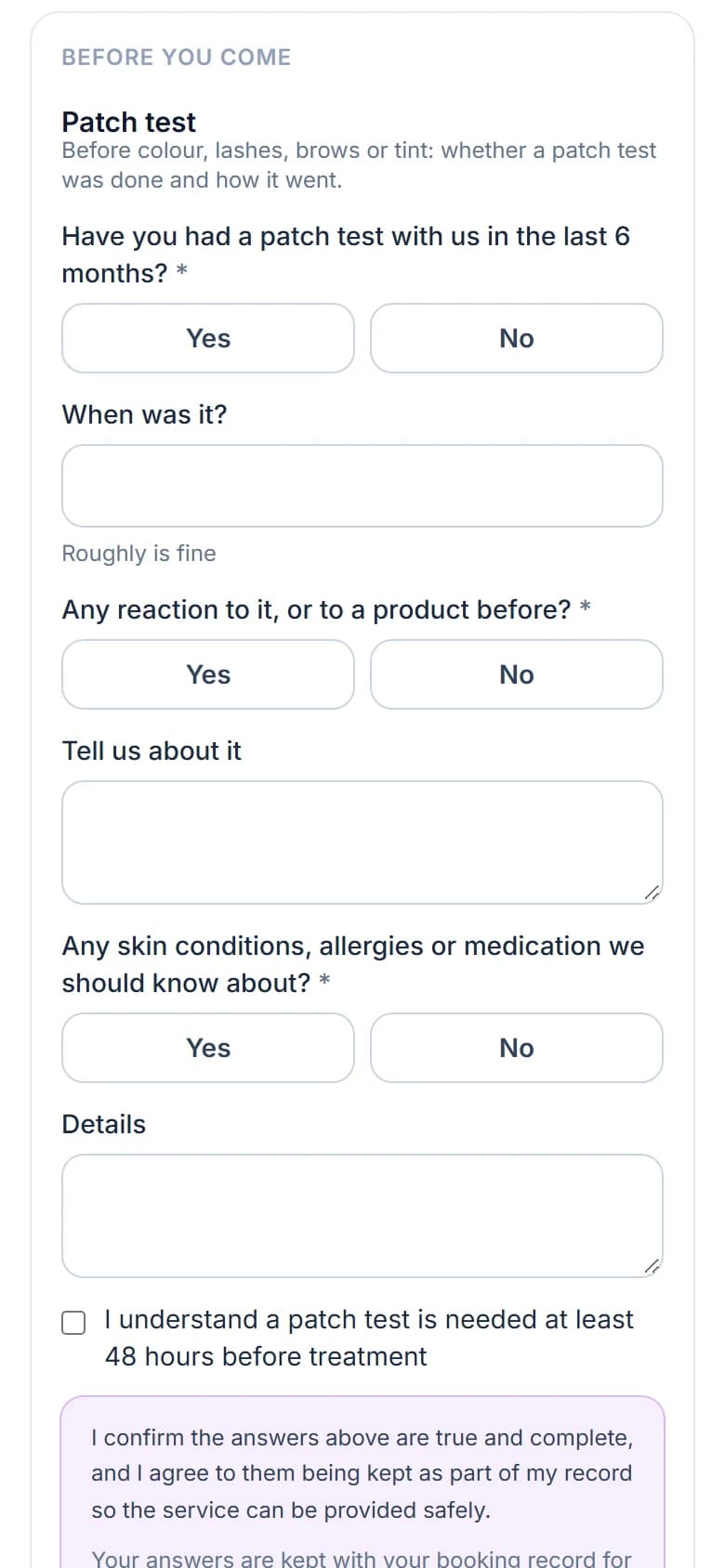
- A Patch test form is ready to add under Your shop, Forms: a patch test in the last 6 months, any reaction, skin conditions, allergies or medication, and a tick to agree a patch test is needed at least 48 hours before treatment. It's asked on the first visit and again after 180 days.
- Add your lash questions to your copy, or add Consent to treatment, which checks for changes and gets agreement every visit.
- Asked when they book, on your booking page, for the services you pick, and signed with a typed name. Each response saves as a PDF on the customer's profile.
- Patch tested before FullDiary? On that client's profile, choose Don't require for this customer and a date, and they won't be asked until then.
- Visit records keep what you used each time, with photos if you like.
Forms are on every plan, free included.
Patch testing for tints and colour has its own rules; our hair dye patch test guide covers them.
Hair dye patch tests: the rules for salons
Sources
The UK and Irish study of (meth)acrylate allergy, including from nail and eyelash glue, reported by the European Medical Journal.
EMJ: (meth)acrylate contact allergy study
Allergic contact dermatitis and how soon it appears, from the NHS.
Health data is special category data under UK GDPR.
Typed signatures: the Law Commission's 2019 report on electronic signatures, summarised by the law firm Womble Bond Dickinson.
Electronic signatures are valid: the Law Commission's report
This guide is general information, not medical or legal advice.
Questions people ask
- Do lash extensions need a patch test?
- It's good practice for new clients and anyone changing adhesive, and many insurers ask for one. 24 to 48 hours before the first set is common; follow your insurer's and training provider's rule.
- What should a lash extension consent form include?
- Allergies, eye conditions, contact lenses, recent eye surgery, medication, past reactions, the patch test result, aftercare, safe removal, and a signature and date.
- Can you be allergic to lash glue after having lashes before?
- Yes. An allergy can develop after several sets, which is why every client should tell you about any new reaction to beauty products.
- Can a client sign a lash consent form online?
- Yes. A typed name and date is a valid way to agree in England and Wales when the person means to sign.
Read next
Written by
Matt SucklingDirector, FullDiary
Matt runs Cynical Software Ltd, the Perthshire company that makes FullDiary, and builds it.