
Guide6 minute read
Massage consultation form: what to ask before a treatment
A massage consultation form tells you what could make a treatment unsafe or change how you do it, and it's your record that you asked. Ask it before the first treatment, check for changes every visit, ask the whole form again once a year, and keep the answers safe.

Director, FullDiary
Most of the time the form is a formality. Then one day it's the client who mentions a recent operation, a blood thinner or a swollen calf, and you're glad you asked before your hands were on them.
Why a consultation form
- Safety: some conditions mean you shouldn't massage at all, or not that area, or not that firmly.
- A better treatment: knowing about an old injury or a desk job tells you where to work.
- Your record: if anything goes wrong, a dated form shows you asked and they answered. The CNHC code expects a case history from registered therapists.
The template: questions to copy
Group the questions into tick lists, with "None of these" at the end of each, so the client answers every group rather than skipping past it.
About you:
- Full name and date of birth
- Address and phone number
- Your GP's name and practice
- Emergency contact: name and phone number
Heart and circulation: tick any that apply
- A heart or circulation condition
- High or low blood pressure
- A blood clot or DVT, now or in the past, or a family history of them
- A bleeding disorder, or taking blood thinners
- Varicose veins
- None of these
General health: tick any that apply
- Pregnant
- Diabetes
- Epilepsy
- Cancer, now or being treated
- Osteoporosis or arthritis
- An operation in the last year
- None of these
Today: tick any that apply
- A fever, cold or infection
- Cuts, bruises, sunburn or a rash
- A recent injury or sprain
- Pain, lumps or swelling you haven't had checked
- Alcohol in the last few hours
- None of these
Then:
- Are you taking any medication, or being treated by a GP or physio? If yes, what for?
- Anything you ticked: tell us more.
- What would you like from today's treatment? Any areas to focus on or avoid?
- Agreement: "My answers are true and complete, I'll tell you if anything changes, and I agree to them being kept on my record so you can treat me safely." Name and date.
Sports massage extras
- What sport or training do you do, and how often?
- Any injury now, and when did it happen?
- Have you got an event or race coming up?
- If you use cupping: do you understand it can leave round, bruise-like marks, and do you agree to it if your therapist thinks it will help?
Answers that mean stop or adapt
Your training tells you which answers rule a treatment out and which mean working around an area or going lighter. The form's job is to make sure you hear them. A few rules that hold whatever your training:
- If you're not sure, don't treat yet. Ask the client to check with their GP first, and rebook. A missed session costs far less than a mistake.
- Signs of a clot are urgent. The NHS lists throbbing pain and swelling in one leg, usually the calf or thigh, with discoloured skin or swollen veins. Don't massage it; tell them to get urgent advice from their GP or NHS 111, and 999 if they're also short of breath or have chest pain.
- Write down what you decided, and why, on their record: treated as normal, worked around an area, or asked them to see their GP.
How often to ask again
- The whole form before the first treatment, and again once a year.
- Every visit, a quick "Any changes to your health or medication since last time?" A new pregnancy, operation or prescription changes the answer.
Keeping the answers
Health answers are special category data under UK GDPR, which means extra care: keep them secure, only let the people treating the client see them, and only keep them as long as you need to.
If you're on the CNHC register (the Complementary and Natural Healthcare Council), its code asks you to take a case history before you treat and keep client records for eight years from the last visit, or for a child until their 25th birthday (26th if they were 17 when treatment ended).
Asking it before they arrive, with FullDiary
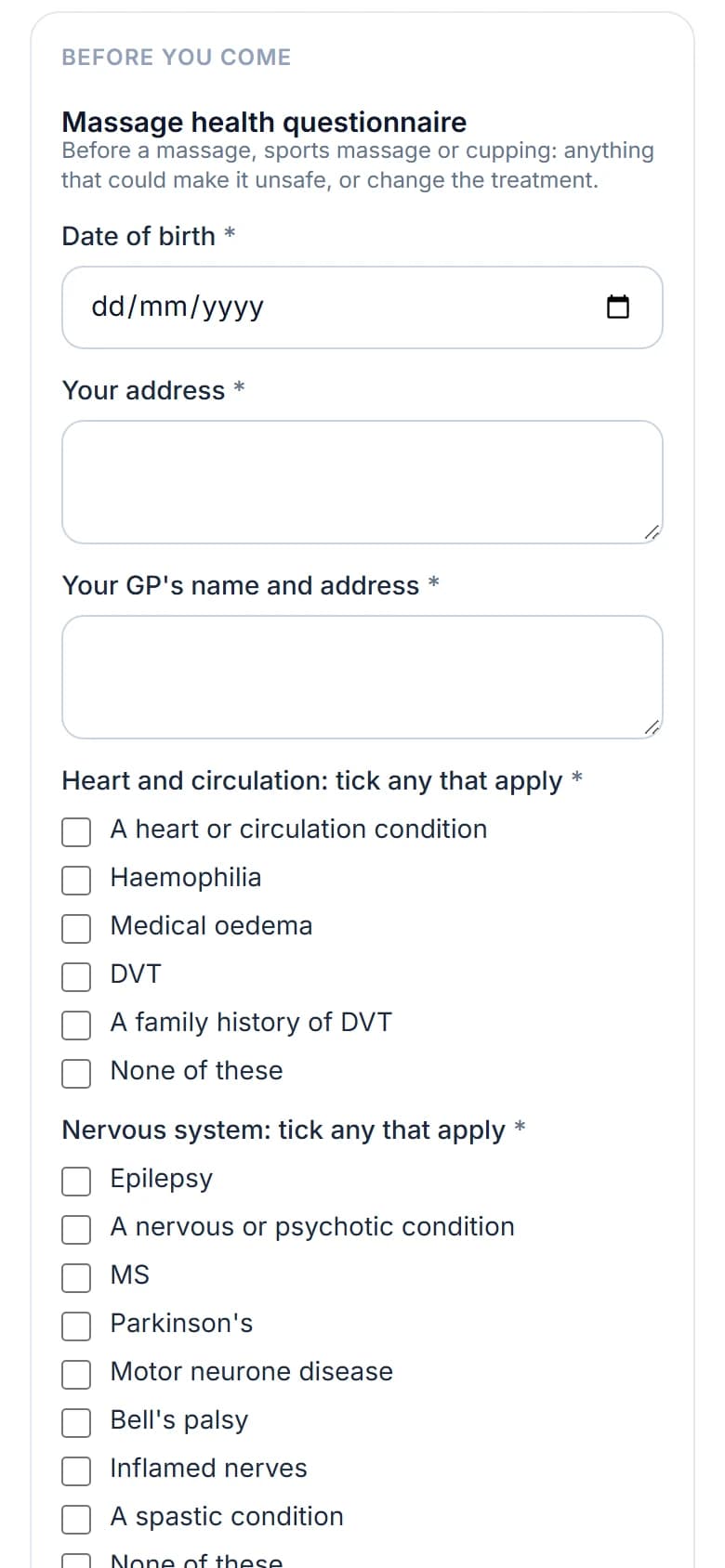
- A massage health questionnaire is ready to add under Your shop, Forms: tick lists for circulation, nerves, bones and joints, general health, today and areas to work around, each ending "None of these", plus cupping questions you can delete if you don't cup.
- Make it yours: change, add, remove or reorder questions; it's your copy.
- Asked when they book, on your booking page, on the first visit and again after a year, for the services you pick. Anything not done yet is asked again on their booked page and in the confirmation email.
- Signed with a typed name, with the agreement wording and a line on how the answers are kept, and saved as a PDF from the customer's profile.
- Your notes after each visit go in visit records, which start with a massage therapist's pain before and after, plus a free note, and stay private unless you choose to share them.
Forms are on every plan, free included.
Sources
Case histories before care, referring clients on, and keeping records for eight years (P.2 and B.8), from the Complementary and Natural Healthcare Council.
CNHC: Code of Conduct, Ethics and Performance
The signs of a DVT and when to get urgent help.
NHS: DVT (deep vein thrombosis)
Health data is special category data under UK GDPR.
Typed signatures: the Law Commission's 2019 report on electronic signatures, summarised by the law firm Womble Bond Dickinson.
Electronic signatures are valid: the Law Commission's report
This guide is general information, not medical or legal advice.
Questions people ask
- What should a massage consultation form include?
- Contact and GP details, health conditions grouped into tick lists, medication, anything that applies today, what the client wants from the treatment, and their signed agreement.
- How often should a client fill in a massage consultation form?
- The whole form before the first treatment and once a year, with a quick check for changes to health or medication every visit.
- What if a client ticks something I'm not sure about?
- Don't treat until they've checked with their GP, and write down what you decided and why.
- How long should I keep massage consultation forms?
- Only as long as you need them under UK GDPR. If you're on the CNHC register, its code asks for eight years from the last visit.
- Can a client sign the form online?
- Yes. A typed name and date is a valid way to agree in England and Wales when the person means to sign.
Read next
Written by
Matt SucklingDirector, FullDiary
Matt runs Cynical Software Ltd, the Perthshire company that makes FullDiary, and builds it.