
Guide6 minute read
Chair rental agreement: what to put in it
Renting out a chair works when both sides know where they stand on rent, clients, products and notice. A written agreement settles it, and it's what HMRC looks at if anyone asks whether your renter is really self-employed.

Director, FullDiary
Chair renting suits a lot of salons and barbershops. The owner fills a chair without taking on an employee, and the stylist runs their own business without paying for premises of their own. Where it goes wrong is when nobody wrote down what was agreed.
How chair renting works
The renter pays you rent, either a fixed amount each week or month or a share of what they take. In return they get a chair or a room, use of the basins and reception, and whatever else you agree. They set their own prices, keep their own takings and find their own clients. You don't pay them, and they don't work for you.
Self-employed or employed?
The word on the agreement doesn't decide it. What matters is how it works in practice. HMRC's guidance for hair and beauty, published in May 2025, says a self-employed renter usually:
- pays you rent for the chair or room
- decides their own hours, days and time off
- finds their own clients
- sets their own prices and is paid by the client directly
- chooses, and may buy, their own products
- earns nothing when they have no appointments
- is free to work somewhere else as well
If you set their hours, hand them your clients, set their prices and pay them a wage or a cut, they may well be an employee, whatever the paperwork says. Put the arrangement through HMRC's Check employment status for tax tool. HMRC stands by its answer as long as what you put in is accurate and stays that way.
Insurance follows the same test. You must have employer's liability insurance for anyone who is in fact your employee, and the HSE says someone treated as self-employed for tax can still count as an employee for this. If you're unsure, ask your insurer.
What the agreement should say
- The space. Which chair or room, the basins, reception and storage they can use, and when they can get in.
- The rent. How much, whether it's fixed or a share of takings, when it's due and what happens if it's late.
- What the rent includes. Towels and laundry, reception cover, the card machine, Wi-Fi, bookings and drinks for clients, and anything that costs extra.
- Products. Whether they bring their own, buy from you or use the salon's at a charge.
- Their own business. They set their prices, keep their takings, keep their own client records and can work elsewhere.
- Clients. Whose clients they are, and what happens to the client list if they leave.
- Insurance. They hold their own public liability and treatment cover, and show you the certificate each year.
- Standards. Health and safety, patch testing, hygiene and how the space is left at the end of the day.
- Notice. How much notice either of you gives, and how a disagreement gets settled.
The NHBF gives its members chair, space and room renting agreements and a guide for each side. Whatever you start from, have it read by a solicitor before anyone signs, and make sure it matches how you really work.
Whose clients are they?
If the renter is truly self-employed, the clients they bring and book are theirs. That matters most on the day they leave. Agree it up front and in writing. Can they take their client list? Do clients the salon passes to them stay with the salon? Can either of you contact the other's clients afterwards?
A renter who keeps their own client list is responsible for it under data protection law. The ICO expects each business that holds its own records to pay its own data protection fee unless it's exempt. For most small businesses that's 52 GBP a year.
VAT on chair rent
If your salon is VAT registered, VAT goes on the rent. HMRC treats a chair rental as a taxable supply rather than an exempt let of property, and the law has said so in terms since 1 October 2012. That covers a chair or a room when it comes with the salon's other services, such as the basins, reception, booking or towels.
Setting up as a renter
A renter is a sole trader. They register for Self Assessment once they earn more than 1,000 GBP in a tax year, telling HMRC by 5 October after the end of the tax year they started.
Booking: one diary or one each?
- Their own FullDiary. Each renter runs their own account, with their own booking page, their own clients and their own Stripe account for deposits. The free plan covers one person and 20 bookings a month.
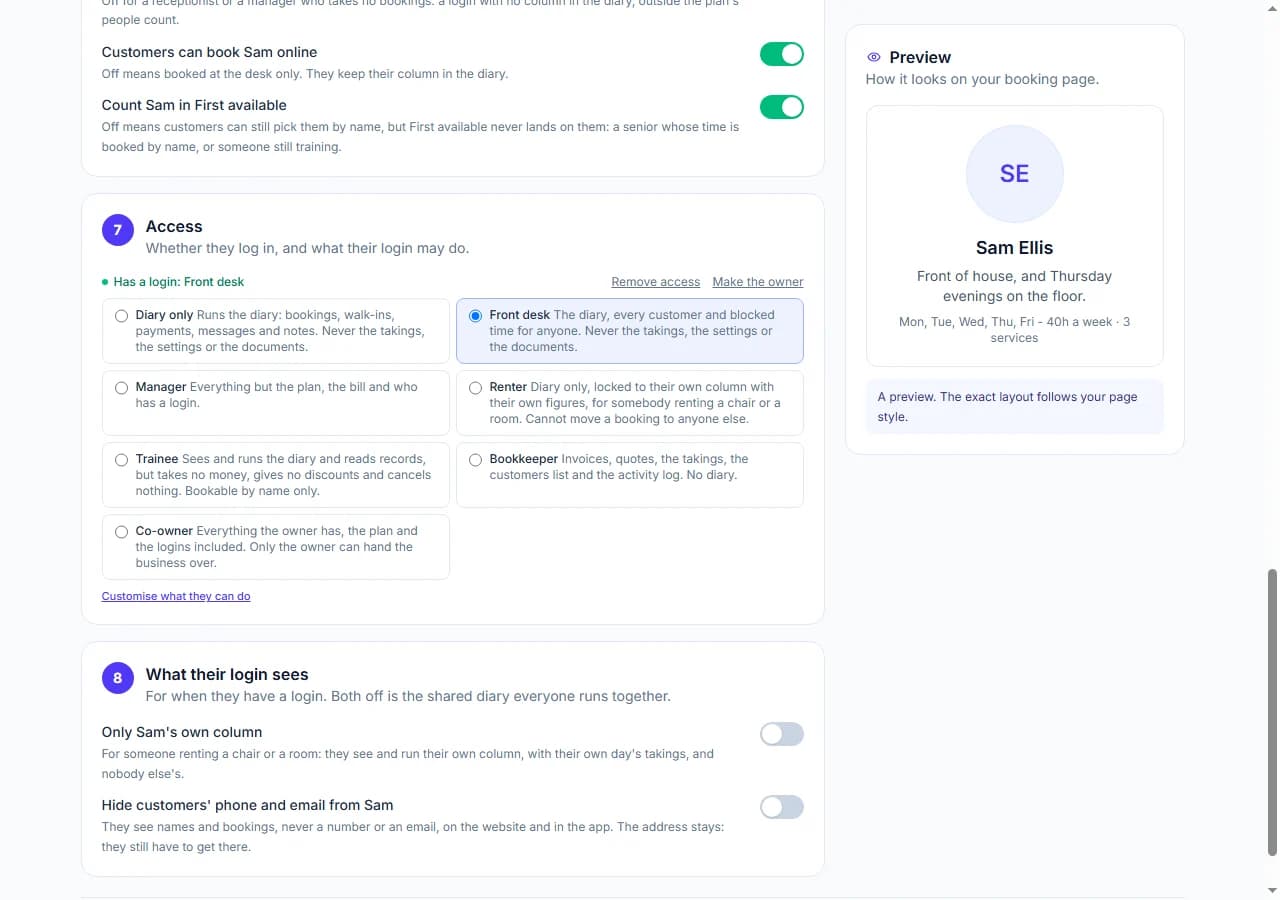
- Or a column in yours. Add them to the salon's diary on Pro with the Renter login, which sees and runs only their own column, bookings and figures, never anyone else's.
- One diary means one account. The client list, the records, and any deposits or card payments taken online belong to the salon's account. Agree in writing how that money is passed on and what happens to their clients if they go.
- Pro is 9.99 GBP a month for each person, never more than 39.99 GBP however big the team.
A renter with clients of their own is usually better on their own account, because the client list and the money are theirs from the first booking.
Help: staff logins and what each can do
Sources
What HMRC looks for in a self-employed renter in hair and beauty.
HMRC: check employment status if you work in hair and beauty
The general signs of self-employment.
gov.uk: what counts as self-employed
HMRC's employment status tool, and when it stands by the result.
HMRC: Check employment status for tax (CEST)
What counts as a chair rental for VAT, and why it's taxable.
HMRC VAT manual: hairdressing salons, chair rentals
The change confirmed in law from 1 October 2012.
HMRC VAT manual: chair rentals, the historic position
Employer's liability insurance, and who counts as an employee for it.
HSE: Employers' Liability (Compulsory Insurance) Act 1969, a brief guide
The data protection fee and its tiers.
ICO: guide to the data protection fee
The NHBF's renting agreements and guides for members.
NHBF: chair, space and room renting
Registering for Self Assessment, and the deadline.
gov.uk: register for Self Assessment
This guide is general information, not legal or tax advice.
Questions people ask
- Is a chair renter self-employed?
- Only if it works that way in practice. HMRC looks at whether they set their own hours and prices, find their own clients, are paid by clients directly and can work elsewhere.
- Do I charge VAT on chair rent?
- Yes, if your salon is VAT registered. HMRC treats a chair rental as a taxable supply, not an exempt let of property.
- What should a chair rental agreement include?
- The space and when they can use it, the rent and what it covers, products, whose clients they are, insurance, standards, and the notice each side gives.
- Do chair renters need their own insurance?
- Yes, their own public liability and treatment cover. If they turn out to be your employee in practice, you need employer's liability insurance for them as well.
- Can a chair renter use my booking system?
- Yes. In FullDiary they can run their own free account, or have a Renter login on your diary on Pro that sees only their own column.
Read next
Written by
Matt SucklingDirector, FullDiary
Matt is a software engineer with over 15 years of experience. He started FullDiary to build a fairer booking system, and he still builds it himself.