Guide7 minute read
How to write an invoice in the UK: what it must include
Every UK invoice needs the same few lines, from a unique number to the total owed. Limited companies and VAT-registered businesses add a few more. Get them right and your invoices get paid without questions.

Director, FullDiary
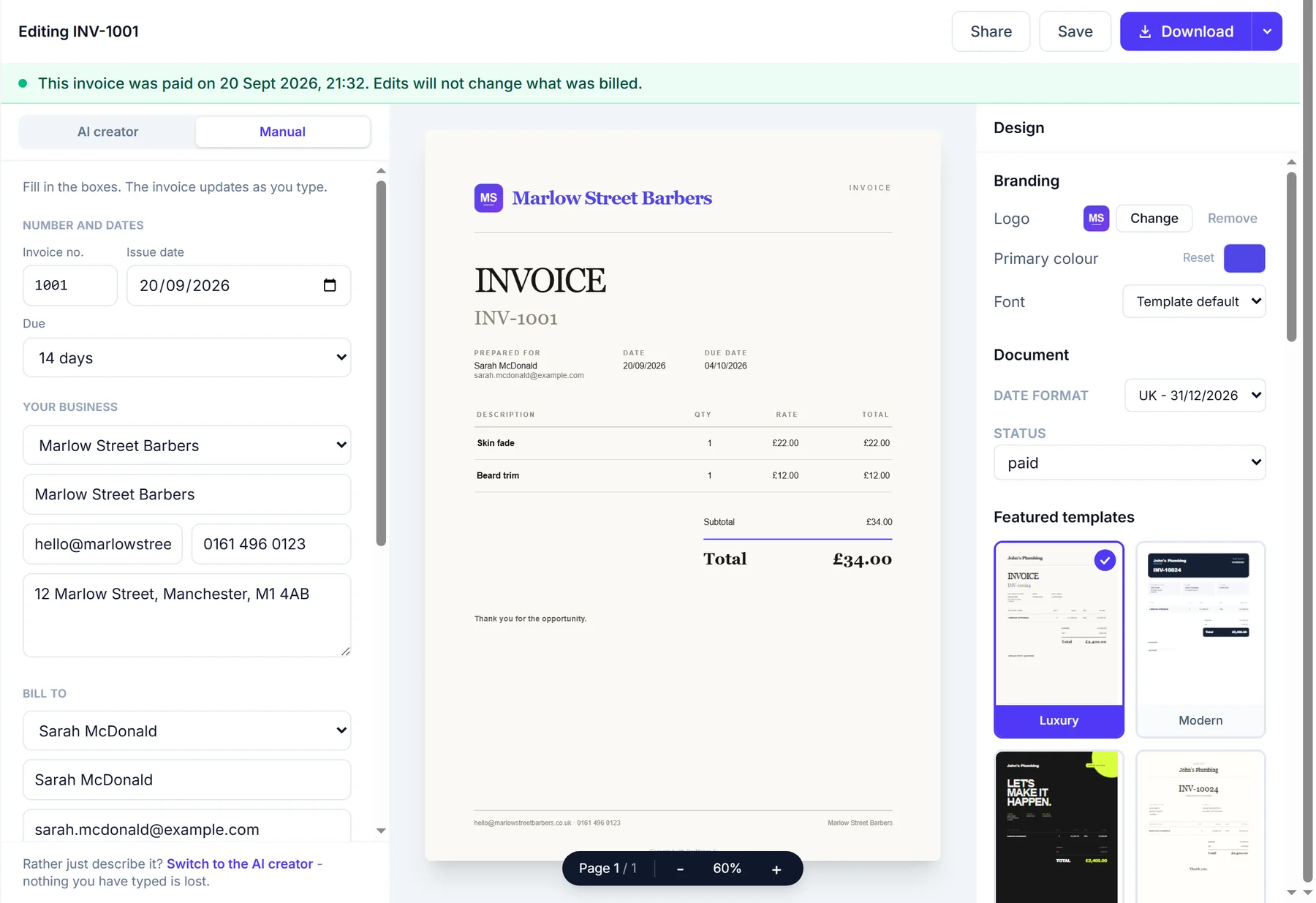
An invoice asks for payment and records the sale, for you, your customer and HMRC. It doesn't need to be fancy. It needs the right lines, so nobody has to come back to you with questions before they pay.
What every invoice must show
- A unique invoice number
- Your business name, address and contact details
- The customer's name, or company name, and address
- A clear description of what you're charging for
- The date you supplied the goods or did the work
- The date of the invoice
- The amount for each item, and the VAT if you charge it
- The total amount owed
Put the word Invoice at the top, so it can't be mistaken for a quote. By law you only have to send an invoice when you and your customer are both VAT registered. Most businesses send one for every job anyway, because it's how they get paid on time and it's the record they keep for tax.
Sole trader or limited company
- Sole traders show their own name and any business name they trade under. If you use a business name, give an address where legal documents can reach you.
- Limited companies show the full company name exactly as it is on the certificate of incorporation. If you name any director on the invoice, name all of them.
- Many companies also add their registered number and registered office. The law asks for those on letters, order forms and your website, so they do no harm on an invoice too.
If you're VAT registered
You must register for VAT once your taxable turnover passes 90,000 GBP over the last 12 months. From then on, an invoice to a VAT-registered customer must be a full VAT invoice, which adds:
- Your VAT registration number
- The time of supply, if it's not the same as the invoice date
- For each line, the quantity, the unit price, the VAT rate and the amount before VAT
- The total before VAT and the total VAT, in sterling
- Any discount for paying early
For a sale of 250 GBP or less including VAT, HMRC allows a simplified invoice, with the total and the VAT rate rather than every line split out. Our VAT invoice page goes through what HMRC checks.
Payment terms and due dates
Payment terms say when the money is due. Choose terms that suit your customers, and print the actual due date beside them so nobody has to count.
- On receipt for work paid on the day, and most personal customers.
- 14 days for most small jobs for other businesses.
- 30 days is what the law gives a business customer when nothing was agreed, counted from when they get your invoice or the work, whichever is later.
- Up to 60 days is the usual limit for agreed terms between businesses.
A line that works on most invoices is "Payment due within 14 days by bank transfer to the account below, quoting the invoice number."
Numbering
- Give every invoice its own number, and never use one twice.
- Run them in order, such as 1001, 1002, 1003. A VAT invoice must have a unique number in sequence.
- Don't delete or renumber an invoice you've sent. Cancel it with a credit note, send a new one and keep a copy of both.
Late payment (business customers only)
When a business pays you late, the Late Payment of Commercial Debts (Interest) Act 1998 lets you claim:
- Interest at 8% a year above the Bank of England base rate. The base rate used is the one on 30 June for debts that go late from July to December, and the one on 31 December for January to June. The base rate was 3.75% on 30 June 2026, so a debt that went late in the second half of 2026 carries 11.75% a year.
- A fixed sum of 40 GBP on a debt under 1,000 GBP, 70 GBP from 1,000 GBP to 9,999.99 GBP, and 100 GBP on 10,000 GBP or more.
- Reasonable costs of getting the money back, if the fixed sum doesn't cover them.
It doesn't apply to personal customers, only to sales between businesses. Most small businesses never charge it, but a line on the invoice saying you can is often enough. The Commercial Payments Bill, before Parliament in 2026, would cap payment terms between businesses at 60 days.
Paper or PDF, and keeping copies
- An invoice can be on paper or electronic. A PDF by email counts, VAT invoices included.
- Sole traders keep their records for at least 5 years after the 31 January Self Assessment deadline for that year.
- Limited companies keep them for 6 years from the end of the financial year they relate to.
- VAT-registered businesses keep VAT records for at least 6 years, with a copy of every sales invoice, cancelled ones included.
Writing invoices with FullDiary
- Fill in the form or describe the job. Type the lines yourself, or tell the AI creator something like "Invoice John Smith 2400 for a new bathroom, due in 14 days" and it writes the invoice.
- Numbered in order. Your first invoice is 1001 and each one takes the next number, or carry on from your own sequence.
- VAT on each line, at 0%, 5% or 20%, worked out in exact pence by ordinary code, never by the AI.
- Your terms, VAT number and bank details saved once and printed on every invoice, with the due date worked out for you.
- From a booking, one press turns a finished appointment into an invoice, with any deposit already taken off.
- On Pro, send it by email with a link to view it and pay by card through your own Stripe account, and FullDiary chases it the day after it's due and again a week later.
Three invoices and three quotes a month are free, with no card. Pro is unlimited, at 9.99 GBP a month for each person.
Rather start from a layout?
Free UK invoice templates you fill in online
Sources
When an invoice is required by law.
gov.uk: invoicing and taking payment from customers
What an invoice must include, for sole traders and limited companies.
gov.uk: invoices, what they must include
Paying within 30 days when no date is agreed.
A business name and address on invoices.
Companies Act 2006, section 1202
Where a company's registered number and office must appear.
gov.uk: company signs, stationery and promotional material
What a VAT invoice must show, and the simplified invoice.
HMRC: VAT guide (VAT Notice 700)
The VAT registration threshold.
Electronic VAT invoices, PDFs included.
HMRC: electronic invoicing (VAT Notice 700/63)
Interest and fixed sums on late business payments, and usual payment terms.
gov.uk: late commercial payments, charging interest and debt recovery
Which base rate applies to a late payment.
Late Payment of Commercial Debts (Rate of Interest) (No. 3) Order 2002, article 4
The Bank of England base rate over time.
Bank of England: Bank Rate history
The proposed 60 day cap on payment terms.
gov.uk: Commercial Payments Bill overview
How long sole traders keep records.
gov.uk: how long to keep your records
How long companies keep records.
gov.uk: company and accounting records
Keeping VAT records and every sales invoice.
This guide is general information, not legal or tax advice.
Questions people ask
- What must an invoice include in the UK?
- A unique number, your business name, address and contact details, the customer's name and address, a description, the supply date, the invoice date, the amounts, any VAT and the total owed.
- Do I have to send an invoice?
- By law, only when you and your customer are both VAT registered. Most businesses send one anyway, because it gets them paid and it's the record they keep for tax.
- How long does a customer have to pay an invoice?
- Whatever you agreed. If you agreed nothing, a business customer must pay within 30 days of getting the invoice or the work, whichever is later.
- Can I charge interest on a late invoice?
- Yes, if your customer is a business. You can claim 8% a year above the Bank of England base rate, plus a fixed sum of 40 to 100 GBP depending on the debt.
- Does an invoice need a VAT number?
- Only if you're VAT registered. Then your VAT number, the rate and VAT on each line, and the total VAT all go on it.
Read next
Written by
Matt SucklingDirector, FullDiary
Matt is a software engineer with over 15 years of experience. He started FullDiary to build a fairer booking system, and he still builds it himself.