
Guide6 minute read
How to start as a mobile hairdresser
Going mobile means no rent and no chair to fill, but your car becomes part of the business. Sort your insurance, price in the travel, claim the mileage and plan each day so you spend it cutting hair, not sitting in traffic.

Director, FullDiary
A mobile hairdresser needs a car, a good kit bag and clients who are happy to have you in their kitchen. There's no salon rent, but the travel costs time and money, so the business only works if you plan for it from the start.
What you need to start
- A kit you can carry. Scissors, clippers, combs and brushes, a dryer and straighteners, gowns, towels, a floor sheet, a water spray and colour bowls, in bags you can lift in and out of the car all day.
- Qualifications. No law says you need one. Anyone can work as a hairdresser in the UK, and joining the Hair and Barber Council's register is voluntary. Insurers do expect a recognised qualification, though, so it decides what you can get cover for.
- Your council. Some councils in England need hairdressers to register with them, and local rules on keeping tools and towels clean can apply even where they don't. Check with yours before you start.
- HMRC. You can start straight away as a sole trader. Once you earn more than 1,000 GBP from trading in a tax year, register for Self Assessment by 5 October after that tax year ends.
- Records from day one. Keep every payment in and every cost, from foils to fuel. Making Tax Digital for Income Tax applies once your income passes 50,000 GBP, falling to 30,000 GBP from April 2027.
Insurance, including your car
- Public liability and treatment cover that include working in clients' homes. Treatment cover is the one that pays if a client reacts to a colour.
- Business use on your car. Social, domestic and pleasure cover doesn't include driving to clients, and nor does commuting cover, which is for driving to one place of work. You need business use.
- Tell your insurer. If you don't, and they'd have charged you more had they known, they can pay only part of a claim. Hide it on purpose and they can cancel the policy and refuse every claim.
- Your kit is worth a lot. Ask whether it's covered in the car and at clients' homes.
Patch tests matter just as much on the road. A new client needs an allergy alert test at least 48 hours before their first colour, so book it as its own short visit before the colour.
Pricing your services and travel
- Time each service from the doorbell to driving away, including setting up, sweeping up and packing the car.
- Add up what each one uses, from colour and developer to foils, gloves and towels you wash.
- Spread your fixed costs, such as insurance, the car, your phone and your booking system, over a normal month.
- Look at what other mobile hairdressers near you charge, then price for the work, not to be the cheapest.
- Decide how you'll charge for travel. You can build it into your prices, charge a flat call-out fee, or charge by the mile.
- Tell clients the travel charge before they book, so the price they agreed is the price they pay.
The travel guide goes through each way of charging, with the sums.
How to charge for travel as a mobile business
Claiming mileage
On simplified expenses you claim a flat rate for each business mile instead of working out what the car really cost you.
- Cars and vans are 55p a mile for the first 10,000 business miles in a tax year, and 25p a mile after that. This went up from 45p on 6 April 2026.
- Motorcycles are 24p a mile.
- The flat rate covers fuel, insurance, repairs and servicing, so you can't claim those as well. Parking is on top.
- Once you use the flat rate for a vehicle, you keep using it for as long as that vehicle is in the business.
- Keep a log of every business journey, with the date, where you went and how far.
Journeys from home to work aren't usually allowed. A mobile hairdresser is different. HMRC's own manual says that when your home is the base of a business that goes from client to client, the trips between home and clients are normally allowable. If you also rent a chair in a salon, the drive from home to that chair isn't.
Planning your day around journeys
- Keep clients in the same area on the same day, and say which days you cover where.
- Leave time between bookings for packing up, driving and finding a space, and allow for school runs and rush hour.
- Set the furthest you'll travel, and stick to it.
- Ask about parking and access when they book, and whether there's a chair near a plug and good light.
- Give long colour appointments a little spare time at the end, so one running late doesn't push back the rest of the day.
Taking bookings and deposits, with FullDiary
- Free for one person, with 20 bookings a month, your own booking page and link, and the diary on your phone in the FullDiary app.
- Their address when they book. Switch on the address question and clients give it as they book, with Find address to check it, and the diary shows it as a map link.
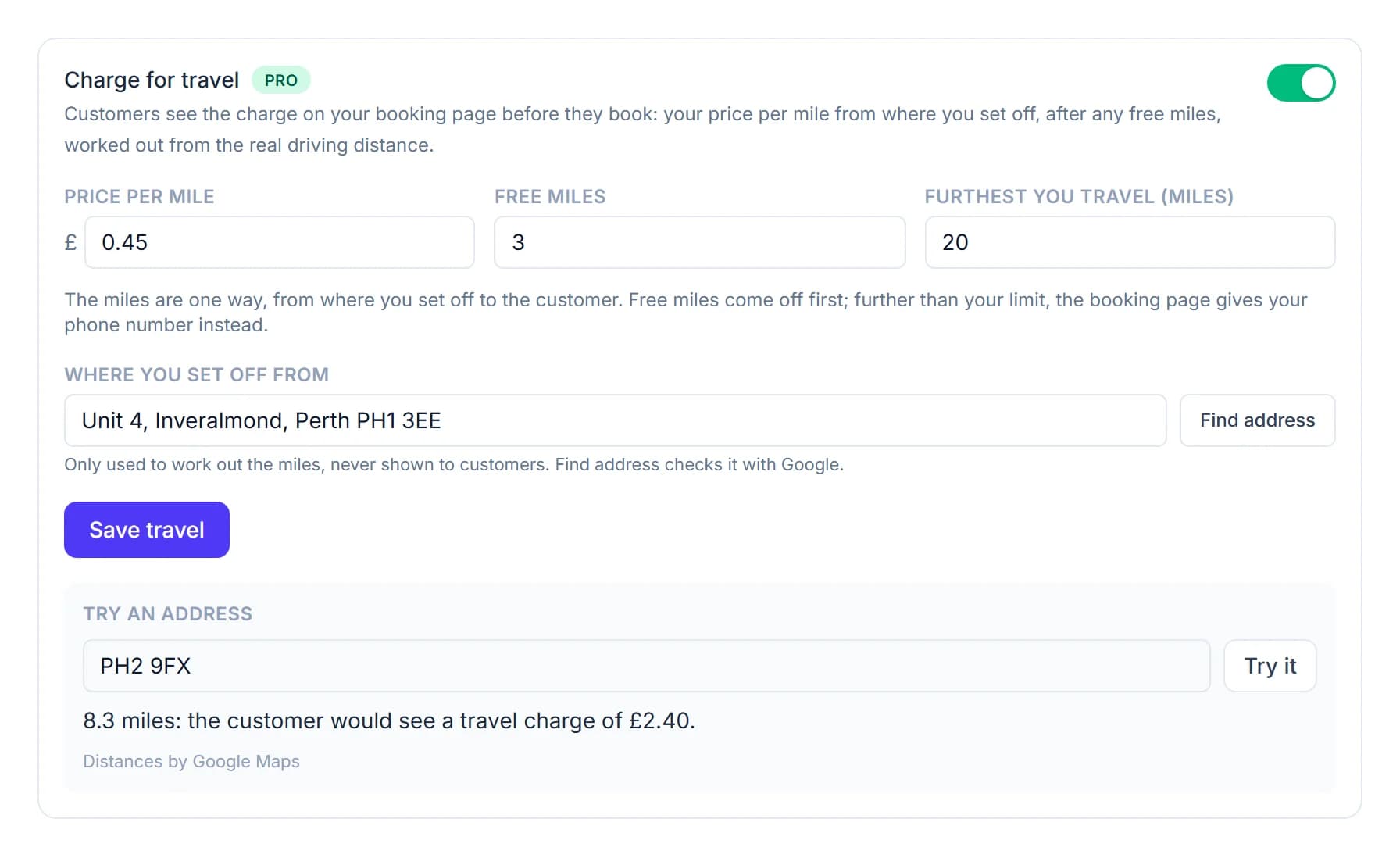
- Travel charges on Pro. Set a price per mile, any free miles and the furthest you travel. FullDiary works out the real driving distance with Google Maps and shows the charge before they book.
- Time to get there. Give a service a clean-up time and the diary keeps that gap free after every booking of it.
- Deposits on every plan, paid by card through your own Stripe account, so a no-show still pays for part of the trip. FullDiary takes no commission.
- When you're busier, Pro is 9.99 GBP a month for one person, with unlimited bookings, travel charges and 50 texts a month for reminders.
See how travel charges work.
Help: can I charge customers for travel?
Sources
No qualification needed, and voluntary registration.
Hair and Barber Council: about us
Registering a hairdressing business with your council in England.
gov.uk: hairdresser registration (England)
Becoming a sole trader.
When to register for Self Assessment.
gov.uk: register for Self Assessment
When Making Tax Digital for Income Tax applies.
gov.uk: Making Tax Digital for Income Tax
Business use on your car insurance.
MoneyHelper: five fibs that could invalidate your car insurance
What an insurer can do when something wasn't declared.
Consumer Insurance (Disclosure and Representations) Act 2012, Schedule 1
Allergy alert tests before colour.
NHBF: setting up an allergy alert testing system
Mileage rates on simplified expenses.
gov.uk: simplified expenses, vehicles
The rise from 45p to 55p a mile, from 6 April 2026.
HMRC: increasing mileage rates
Travel from home when you go from client to client.
HMRC Business Income Manual: BIM37620
Travel between home and a fixed place of work.
HMRC Business Income Manual: BIM37605
This guide is general information, not legal, tax or insurance advice.
Questions people ask
- Do I need a qualification to be a mobile hairdresser?
- Not by law. Anyone can work as a hairdresser in the UK. Insurers expect a recognised qualification, so it decides what cover you can get.
- Do I need business car insurance as a mobile hairdresser?
- Yes. Driving to clients is business use, which social and commuting cover don't include. If you don't tell your insurer, a claim can pay out less or not at all.
- How much mileage can I claim?
- On simplified expenses, 55p a mile for the first 10,000 business miles in a tax year and 25p after that, instead of fuel and running costs.
- Can I claim the drive from home to a client?
- Normally, yes, when your home is the base of a business that goes from client to client. The drive from home to a chair you rent in a salon isn't allowed.
- Should I charge clients for travel?
- That's your choice. Build it into your prices, charge a flat call-out fee or charge by the mile, and tell clients the charge before they book.
Read next
Written by
Matt SucklingDirector, FullDiary
Matt is a software engineer with over 15 years of experience. He started FullDiary to build a fairer booking system, and he still builds it himself.